

Choose one simple format, tie it to a time you already keep, and allow yourself to write three lines. A journal that survives is usually short and a little dull on most days, and that is fine.
The Royal Voluntary Service describes journaling as a reflective act of writing down thoughts and feelings in order to understand ourselves more clearly, and says that no writing experience is needed. There is nothing else to qualify for. What follows is mostly about getting past the second week, which is where a new habit tends to wobble.
Lower the bar before you buy anything
A beautiful blank book can make the first page feel like a performance. If that sounds familiar, spoil it deliberately. Write the date and something ordinary, such as what you had for lunch. You will not be asked to read it aloud, and a first page that has already gone slightly wrong removes the pressure from all the others.
Decide on a minimum in advance. Three lines is plenty. On a good day you will write more without having planned to. On a bad day you will still have kept the habit, and it is the unbroken habit, not the eloquence, which you will be pleased about later.
Choose a page format
A format answers the question "what do I write?" before you sit down. Here are four that work without any special skills. Stick with one for a month before you judge it.
- The line-a-day
- One or two sentences for each date. It takes under a minute, it can run for years, and looking back over it is oddly moving because you can see how much you forgot.
- The ledger
- Facts only: the weather, who you saw, what you read, what you made for dinner. If you dislike writing about feelings, start here. Reflections often turn up by themselves.
- The free page
- Fill one page without stopping or correcting. It is the most searching of the four, and the easiest to give up, so keep it for a time when you have ten undisturbed minutes.
- The prompted entry
- Answer the same two or three questions each evening. What went better than expected? What is still on your mind? What needs doing tomorrow? Repeating them is the point, since you can then compare one month with another.
Anchor it to something you already do
"When I have time" is not a time. Link the journal to a thing that already happens, like the first cup of tea, the train home, or getting into bed. Keep the book and the pen where that thing happens, so the only decision left is whether to pick them up.
If you miss a day, leave the gap and carry on. Do not back-fill a week from memory, as catching up turns a pleasure into admin, and a list of overdue entries is a very efficient way to end a habit altogether.
Writing down worries
Some people start a journal because their head is noisy at night. There is NHS advice on this. Every Mind Matters suggests setting aside "worry time", a short period of perhaps 10 or 15 minutes, every day or so before bed, to write things down and try to find solutions. It notes that getting things out of your head and on to paper can sometimes help to clear your mind. An Oxford NHS trust’s page for young people says something similar: writing down your worries can make them feel easier to deal with.
In practice that may be a list and not an essay. Split it into what you can do something about and what you cannot, and pick one small next step from the first column. Then close the book.
Writing can be a useful habit, but it does not replace care. If low mood or anxiety is getting in the way of your daily life, or the writing is leaving you feeling worse, talk to your GP. If you are in crisis or worried about your safety, the NHS Every Mind Matters site links to urgent support, and 999 is there for an emergency.
Keep it private, and say so to yourself
You will censor yourself if you think someone may read it. Decide where it lives and who knows. If you share a home, a drawer you trust may be enough. Tell yourself that you can tear out or destroy a page whenever you please. Knowing that you could get rid of a page may make it easier to write honestly.
The pen and the paper, briefly
Stationery will not make you write, but a tool you enjoy gives you one more reason to sit down. A notebook that lies flat is easier for writing near the gutter, and a size you can carry goes where you do. If you use a fountain pen, a five-minute test on the back page tells you if you can write on both sides. A fine nib gets more words on a small page and dries faster, which helps when you close the book in a hurry.
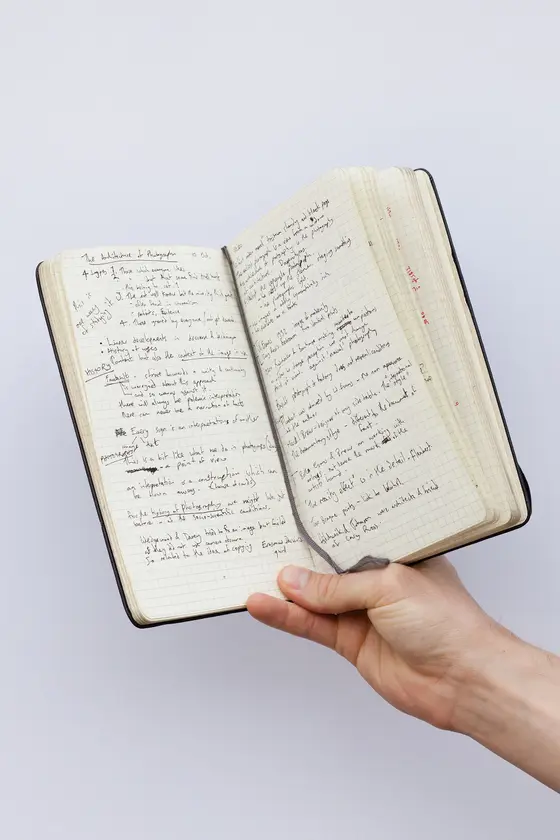

If you hope your grandchildren will read it, or just want it to outlast you, ink choice starts to matter. Most ordinary inks are fine in a closed book, but our entry on inks that last sets out which ones to consider, and how to store the finished volumes.
When it stops working
Most journals go through a dull spell. Change the format before you quit: drop to a line a day, move it from night to morning, or use a different book. And look back occasionally. Reading an entry from a year ago can be a good reason to carry on, because it may show you a detail you would otherwise have lost.