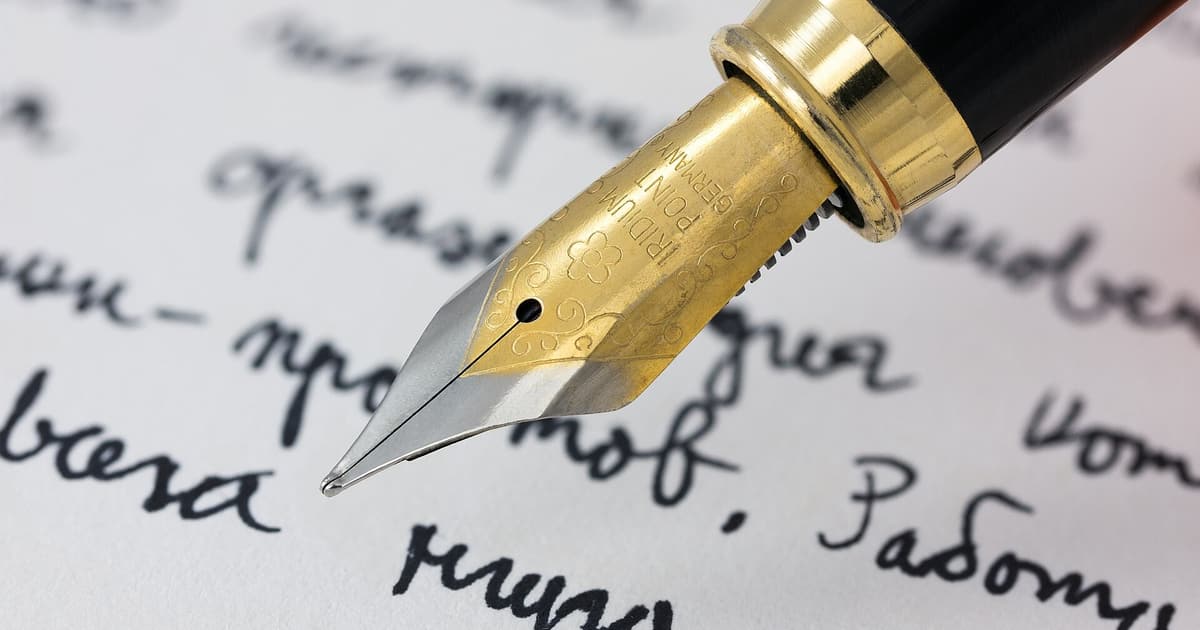

Look for smooth, well-sized paper, and treat around 90 to 100gsm as a useful starting point. Sizing is the treatment that limits how much water the fibres take up, so a well-sized lighter sheet can beat a heavier one that is left absorbent.
Notebook labels do not always tell you which is which, so the useful skill is telling what has gone wrong on the page, and testing a sheet for yourself.
Three different problems
These words get used interchangeably, but each one points to something different.
| What you see | What it is | Usual culprit |
|---|---|---|
| Fuzzy edges on the line | Feathering. Ink creeping along the fibres | Absorbent paper, or too little sizing |
| Dots and lines on the back | Bleed-through. Ink passing right through | Thin or absorbent paper, or a very wet pen |
| A faint image, but a clean reverse | Show-through, or ghosting | Paper that is not opaque enough |
Definitions vary a little between sellers, but Pure Pens and Ferris Wheel Press describe feathering and bleed-through in these terms. Show-through is often a matter of taste. Many people happily write on both sides of a sheet with a faint shadow behind.
What sizing does
Paper is a mat of fibres, and left untreated those fibres drink water. Sizing is what the papermaker adds to slow them down. A paper-conservation study in the Journal of the American Institute for Conservation puts it directly: sizing is applied to hinder water absorption into the fibre and to prevent the feathering of water-based ink lines. Fountain pen ink is water-based, so that is the whole problem in a sentence.
Ballpoint ink is oil-based and thicker, which is why a cheap pad that behaves perfectly with a biro can look dreadful under a nib. The pad has not changed. Your ink has, and the paper was never made with it in mind.
What gsm does and does not tell you
GSM means grams per square metre, a measure of weight. Paper sizes make the sum easy. A0 has an area of one square metre, and A4 is a sixteenth of that, so as Markus Kuhn of the University of Cambridge sets out, a sheet of ordinary 80 g/m² office paper weighs about 5g. Nothing in that figure tells you how the sheet was sized.
Weight still has its uses. A heavier sheet generally gives ink further to go and shows less on the reverse. The retailer Pure Pens calls 90 to 100gsm the sweet spot for fountain pens and treats 80gsm as a minimum. It also says that a smooth 90gsm sheet can outperform a rough 100gsm one, which is the same point from the other direction. Treat those numbers as a shop's rule of thumb and not as a standard.
Smoothness has a trade-off
A hard, smooth surface lets a nib glide and keeps a line crisp, and ink sits on top for longer. That also means it dries more slowly, which matters to left-handers and fast writers. Rougher, softer sheets dry faster because they are absorbing, and they may feather as they do it. There is no sheet that wins on every count, so decide which failure you mind least.
Test any notebook in five minutes
Labels such as "fountain pen friendly" are a seller's description, so a simple page test tells you more. Use the last page, so that nothing shows at the front.
- Write a few lines with your usual pen and at your usual speed.
- Write one word slowly, and rest the nib still on the page for a second at the end. Slow writing lays down the most ink.
- Draw a thick block by going over the same spot three or four times.
- Time how long the line takes to stop smudging under a clean finger.
- Wait until it is dry. Look at the edges of the letters closely, in good light, then turn the page over.
If the words look clean but the block has come through, the paper is probably fine for everyday writing. If the normal lines have fuzzy edges, that is a poor match for this pen and ink. Try a finer nib or a drier ink before you give up on it. Nib width changes how much ink reaches the page, so the same notebook may behave for a fine nib and fail for a broad one.
Choosing a format
Most UK notebooks follow the A series. A4 is 210 by 297mm and A5 is 148 by 210mm, each exactly half the size of the one above. A5 suits a journal you carry, and A4 works better for long notes on a desk. Binding matters too, since a book that lies flat is easier on the wrist and keeps the page steady as you write. That counts for more if you plan to keep a journal over a long period, because you will be writing right up against the gutter.
If it needs to last
Good writing behaviour and long life are separate qualities. For records that will be kept for decades, look for paper described as archival or acid-free and pair it with a suitable ink. We deal with that in which ink lasts, along with what archivists say to avoid.